Why being rude?
Fair question. Here’s how Rude compares to Flake8 and Fixit — the tools it replaces — and how it complements Ruff.
At a glance
Rude |
Ruff |
Flake8 |
Fixit |
|
|---|---|---|---|---|
Language |
Python + Rust (PyO3) |
Rust |
Python |
Python (LibCST) |
Parser |
tree-sitter (vendored in Rust) |
custom Rust |
stdlib AST + tokenizer |
LibCST (CST) |
Custom rules in Python |
yes |
no |
yes (plugins) |
yes (local rules) |
Built-in rules |
104 (+ 43 via plugins) |
800+ |
~100 (+ plugin ecosystem) |
~30 |
Autofix |
yes |
yes |
no |
yes (CST-aware) |
Formatter |
no |
yes |
no |
no |
Error recovery |
yes |
yes |
no |
no |
Semantic analysis |
yes (Rust) |
partial |
no |
no |
Parallel execution |
yes |
yes |
yes |
no |
Incremental cache |
no |
yes |
no |
no |
Configuration |
pyproject.toml |
pyproject.toml / ruff.toml |
.flake8 / setup.cfg |
pyproject.toml (hierarchical) |
Performance
Reference results
The numbers below come from a single benchmark run on a dedicated machine with no other workload. Results may vary on your hardware — run the benchmark yourself to get local numbers (see Methodology below).
The headline number
Rude lints 901 Django files in 0.76s / 64 MB in its default single-process mode. Flake8 takes 13.0s single-threaded on equivalent AST rules – 17x slower. Even with all 16 CPUs, Flake8 only reaches 1.64s.
Tier 1 — AST-semantic rules (3-way, 10 equivalent rules)
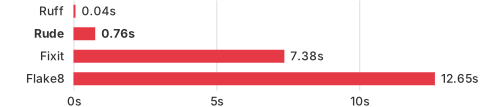
Django (901 files) — 10 equivalent rules, single process
Tool |
Jobs |
Wall time |
Memory |
Diags |
LOC/s |
|---|---|---|---|---|---|
Rude |
1 |
0.76s |
64 MB |
220 |
212,746 |
Rude |
auto |
0.74s |
63 MB |
220 |
218,724 |
Flake8 |
1 |
13.03s |
49 MB |
0 |
12,445 |
Flake8 |
auto |
1.64s |
— |
0 |
98,599 |
Ruff |
auto |
0.06s |
103 MB |
492 |
2,810,679 |
Flake8 single-threaded is 17x slower than Rude (13.0s vs 0.76s). Even with all 16 CPUs (auto), Flake8 at 1.64s is still slower than Rude on a single process. Rude’s speed comes from Rust-powered tree-sitter parsing, semantic analysis, and pre-computed line metadata via rayon.
Tier 2 — Full E/W/F/C rules (Rude vs Flake8, ~104 rules)

Django (901 files) — ~104 rules, single process
Tool |
Jobs |
Wall time |
Memory |
Diags |
LOC/s |
|---|---|---|---|---|---|
Rude |
1 |
4.02s |
67 MB |
5,058 |
40,297 |
Rude |
auto |
4.00s |
69 MB |
5,058 |
40,549 |
Flake8 |
1 |
13.51s |
50 MB |
5,267 |
12,000 |
Flake8 |
auto |
1.76s |
— |
5,267 |
92,290 |
Ruff |
auto |
0.04s |
1 MB |
527 |
4,148,421 |
Flake8 single-threaded is 3.4x slower than Rude (13.5s vs 4.0s). With all
16 CPUs, Flake8 at 1.76s overtakes single-process Rude – this is where
--jobs=N matters. The bottleneck is Python rule execution (see parallelism
model below).
Parallel scaling. Rude’s --jobs=N enables subprocess parallelism for
Python rules. In Tier 1 (10 lightweight AST rules), the Rust rayon pipeline
handles most of the work – --jobs has minimal effect. In Tier 2 (~104 Python
rules), --jobs=N provides near-linear scaling as Python rule execution
dominates. Run benches/comparative/compare.py --jobs 1,2,4,8,16 for detailed
scaling data on your hardware.
Throughput – large corpus (162k LOC)
Tool |
Tier 1 (LOC/s) |
Tier 2 (LOC/s) |
|---|---|---|
Rude (1j) |
213k |
40k |
Flake8 (1j) |
12.4k |
12.0k |
Flake8 (auto) |
99k |
92k |
Rude single-threaded sustains 213k LOC/s on tier 1 – Flake8 manages 12.4k (17x less). On tier 2 with ~104 Python rules, Rude processes 40k LOC/s vs Flake8’s 12.0k (3.4x less).
Note
About diagnostic counts. Rude reports 5,058 diagnostics on Django (tier 2) while Flake8 reports 5,267. Each tool implements a slightly different subset of the E/W/F/C rules, with different defaults for edge-case behavior. Tier 1 counts are closer (Rude: 220, Flake8: 260) because those 10 rules are the most standardized.
Startup latency (1 file, 1 LOC)
Tool |
Wall time |
Memory |
|---|---|---|
Rude |
90 ms |
56 MB |
Ruff |
90 ms |
44 MB |
Flake8 |
120 ms |
62 MB |
Fixit |
280 ms |
71 MB |
Interpretation
Rude is the fastest Python-extensible linter available. On AST-semantic rules (Tier 1), a single Rude process lints Django in 0.76s – Flake8 needs 13.0s single-threaded (17x slower) or all 16 CPUs to reach 1.64s (still slower than single-process Rude).
On full E/W/F/C rules (Tier 2), Flake8 single-threaded is 3.4x slower than
Rude (13.5s vs 4.0s). With all CPUs, Flake8 at 1.76s overtakes single-process
Rude – this is where --jobs=N matters for Rude as well, enabling subprocess
parallelism for Python rules.
Ruff is in a class of its own for raw throughput – it’s pure Rust with no Python overhead. Since it doesn’t support custom rules, Rude is designed as a complement: Ruff for standard checks, Rude for your own.
Methodology
The benchmark uses benches/comparative/compare.py, which runs each tool as an
independent subprocess with per-process CPU time measurement (via
resource.getrusage deltas) and peak memory tracking (via psutil polling the
specific child PID). No tool is given an unfair advantage – all share the
same constraints:
Corpus. Real-world Python projects downloaded from GitHub:
Corpus |
Source |
Files |
LOC |
|---|---|---|---|
large |
django/django |
901 |
162,163 |
huge |
home-assistant/core |
8,910 |
1,309,498 |
Rule selection. Two tiers ensure both narrow and broad comparisons:
Tier 1 – 10 AST-semantic rules that all tools implement:
E711, E712, E721, E722, E731, E741, E401, F631, F901, C901.Tier 2 – All
E,W,F,Crules. Fixit is excluded because it does not implement pycodestyle or pyflakes checks.
Tool invocation. Each tool is run via subprocess to include real-world
startup cost. Parallelism is tested at --jobs=1 (single process) and
--jobs=auto (default, usually all CPUs for flake8, single process for rude).
Timing. Wall-clock time is measured with time.monotonic(). CPU time uses
resource.getrusage(RUSAGE_CHILDREN) deltas (before/after each subprocess) for
accurate per-process measurement. Peak RSS is sampled via psutil.Process(pid)
in a background thread at 50ms intervals. Each configuration is run 5 times;
the tables report the median.
Internal benchmarks. In addition to the comparative benchmark, the project includes:
criterion (Rust) – benchmarks for
do_analyze_result,compute_line_infos,compute_style_flags,collect_grouped_nodespytest-benchmark (Python) – benchmarks for
analyze_source,group_nodes,Linter.check_file,NodeProxypatterns
Test environment.
CPU |
Intel Core i9-9900K @ 3.60 GHz (8 cores / 16 threads) |
RAM |
32 GB DDR4 |
Storage |
NVMe (Corsair MP600 PRO) |
OS |
Debian (Linux 6.1.0-42-amd64) |
Python |
3.11.2 |
Rude |
0.1a2 |
Flake8 |
7.3.0 |
Reproduce. Run the benchmarks on your own hardware:
# Download the corpus
uv run python benches/corpus/download.py

# Comparative benchmark (rude vs flake8 vs ruff)
uv run --group bench python benches/comparative/compare.py --output results.json

# Rust internal benchmarks (criterion)
cargo bench

# Python internal benchmarks (pytest-benchmark)
uv run --group bench pytest benches/python/ --benchmark-only -v
See benches/comparative/compare.py --help for options (corpus selection, job
counts, number of runs).
Parallelism model
Rude’s architecture splits work between Rust and Python:
┌────────────────────────────────────┐
│         Single process (default)   │
│                                    │
│  ┌──────────────────────────────┐  │
│  │  Rust rayon (all CPUs)       │  │
│  │  · File I/O                  │  │
│  │  · tree-sitter parsing       │  │
│  │  · Semantic analysis         │  │
│  │  · Pre-computed line metadata│  │
│  └──────────┬───────────────────┘  │
│             │ yields results       │
│  ┌──────────▼───────────────────┐  │
│  │  Python (main thread)        │  │
│  │  · Line rules                │  │
│  │  · AST rules                 │  │
│  └──────────────────────────────┘  │
│  Memory: ~67 MB (constant)         │
└────────────────────────────────────┘
The default mode keeps memory low because only one Python process exists, and rayon streams results through a bounded channel (capacity 8) so at most a few files are materialized at any time.
The bottleneck is Amdahl’s law: rayon parallelizes the Rust phases across all CPUs, but Python rules are serialized by the GIL. As the number of Python rules grows (Tier 2 has ~104), the serial Python fraction dominates wall time.
--jobs=N breaks through the GIL by spawning N subprocesses:
┌──────────────────────────────────────────────┐
│         --jobs=N (multiprocess)               │
│                                               │
│  ┌──────────┐  ┌──────────┐     ┌──────────┐ │
│  │ Worker 1 │  │ Worker 2 │ ... │ Worker N │ │
│  │ rayon    │  │ rayon    │     │ rayon    │ │
│  │ Python   │  │ Python   │     │ Python   │ │
│  └──────────┘  └──────────┘     └──────────┘ │
│  Memory: ~N × 67 MB                          │
└──────────────────────────────────────────────┘
Each worker gets a balanced chunk of files (LPT scheduling by file size) and
runs the full pipeline independently. Rayon threads per worker are automatically
scaled to cpu_count / N so the total thread count matches the available cores.
When to use --jobs
Scenario |
Recommendation |
|---|---|
Any codebase |
Default ( |
Large codebase, max speed |
|
CI with max speed priority |
|
Specific worker count |
|
Why not Python threads?
Python’s GIL (Global Interpreter Lock) prevents parallel execution of Python bytecode within a single process. Since lint rules are CPU-bound Python code, threading would add overhead without parallelism. Multiprocessing is the only way to achieve true Python parallelism with CPython.
Note
Free-threaded Python (3.13t+) removes the GIL and could eventually allow thread-based parallelism for Python rules — shared memory with no subprocess overhead. This is not yet supported as the ecosystem (PyO3, extensions) is still maturing.
Extensibility
Rude |
Ruff |
Flake8 |
Fixit |
|
|---|---|---|---|---|
Write rules in Python |
yes |
no |
yes |
yes |
Local rules (no package needed) |
yes |
no |
no |
yes |
Plugin system |
entry points |
n/a |
entry points |
module paths |
Configurable rule templates |
yes |
no |
no |
no |
Rule types |
AST, Line |
Rust only |
AST, logical line, physical line |
CST visitor |
Test helpers for rules |
yes ( |
n/a |
no |
yes (inline VALID/INVALID) |
Rude and Fixit are the best choices when you need project-specific rules.
Rude offers configurable templates (RequireBaseClass, ForbiddenCall, etc.)
that cover common patterns without writing code. Fixit provides inline test
cases and CST-aware transforms. Flake8 requires publishing a plugin package.
Ruff does not support custom rules at all — Rude fills that gap.
Semantic analysis
Capability |
Rude |
Ruff |
Flake8 |
Fixit |
|---|---|---|---|---|
Scope resolution |
yes (Rust) |
partial |
no |
no |
Binding tracking |
yes (Rust) |
partial |
no |
no |
Qualified name resolution |
yes |
no |
no |
no |
Ancestor context flags |
yes ( |
no |
no |
no |
Unused import detection |
yes (semantic) |
yes |
yes (pyflakes) |
no |
Undefined name detection |
yes (semantic) |
yes |
yes (pyflakes) |
no |
Rude’s SemanticModel is built in Rust and exposed via PyO3. It resolves
scopes, bindings, and references in a single pass, giving rules access to
information like “is this variable used?” or “what does this name resolve to?”
without re-parsing.
Auto-fix quality
Rude |
Ruff |
Flake8 |
Fixit |
|
|---|---|---|---|---|
Fix mechanism |
byte-level edits |
byte-level edits |
none |
CST transforms |
Import management |
yes |
yes |
no |
no |
Preserves formatting |
partial |
partial |
n/a |
yes (CST) |
Fix conflicts resolved |
yes (atomic, non-overlapping) |
yes |
n/a |
yes |
Fixit has the most precise auto-fix thanks to LibCST concrete syntax tree
transforms. Rude and Ruff use byte-range edits, which are fast but less
format-aware. Rude adds import management to fixes (e.g., a rule can add
import logging when replacing print() with logger.debug()).
Built-in rule coverage
Category |
Rude |
Ruff |
Flake8 |
Fixit |
|---|---|---|---|---|
Pyflakes (F) |
yes |
yes |
yes |
no |
Pycodestyle (E/W) |
yes |
yes |
yes |
no |
McCabe complexity (C) |
yes |
yes |
yes |
no |
Import sorting |
no |
yes |
plugin (isort) |
no |
Code modernization (UP) |
yes (partial) |
yes |
plugin (pyupgrade) |
partial |
Security (S/bandit) |
partial (eval/exec) |
yes |
plugin (bandit) |
no |
Bug prevention (B) |
yes (partial) |
yes |
plugin (bugbear) |
partial |
Comprehension simplification (C4) |
yes |
yes |
no |
no |
Code smells (PAT) |
yes |
no |
no |
no |
Hygiene (META) |
yes |
no |
no |
no |
Configurable templates (EX) |
yes |
no |
no |
no |
Ruff has by far the largest built-in rule set (800+), re-implementing rules from 50+ Flake8 plugins. Rude focuses on the core checks (pyflakes, pycodestyle, complexity) plus unique categories like code smells, hygiene, and configurable templates that no other tool provides. Fixit ships only ~30 rules and is primarily a framework for writing your own. Flake8 requires third-party plugins for most categories beyond pycodestyle and pyflakes.
Monorepo support
Rude |
Ruff |
Flake8 |
Fixit |
|
|---|---|---|---|---|
Hierarchical config |
no |
partial (per-file-ignores) |
no |
yes |
Per-directory rules |
via local-rules |
no |
no |
yes |
Per-file overrides |
via |
via per-file-ignores |
via |
via config |
Fixit was designed at Meta specifically for large monorepos with per-team
configuration. Ruff supports per-file-ignores for selective rule disabling.
Rude supports local-rules paths but does not yet have hierarchical config
files.
When to use what
Use Ruff when…
You want maximum speed with zero configuration.
Standard rules (PEP 8, import sorting, code modernization) cover your needs.
You want a single tool replacing flake8 + black + isort + pyupgrade.
Use Rude when…
You need custom rules specific to your project or organization.
You want semantic analysis (scopes, bindings) available in Python rules.
You want configurable rule templates without writing code.
You already use Ruff for standard checks and need a complement for custom ones.
Use Fixit when…
You need CST-aware auto-fixes that precisely preserve formatting.
You work in a monorepo with per-team hierarchical configuration.
You want the lowest boilerplate for writing rules (inline test cases).
Use Flake8 when…
You have an existing investment in Flake8 plugins that aren’t yet in Ruff.
Your team is familiar with the tool and migration cost isn’t justified.
Using Rude alongside Ruff
Rude is designed to complement Ruff, not replace it. A typical setup:
# Ruff handles standard checks + formatting
ruff check src/ && ruff format src/

# Rude handles custom organization rules
rude check src/
# pyproject.toml
[tool.ruff.lint]
select = ["E", "F", "I", "UP", "B", "SIM"]

[tool.rude]
select = ["PAT", "META", "EX"]
local-rules = ["tools/lint/rules.py"]